February 1st, 2026
The hidden climate vulnerability: how flies and cockroaches thrive after disasters
By Robert Jones, Arctech Innovation
When climate disasters strike, public health responses often focus on the most visible risks: injuries, unsafe water, and food shortages. Outbreaks of water-borne diseases are a major concern, and mosquitoes can also proliferate after flooding, contributing to dengue and other arboviral outbreaks.i Yet one group of organisms consistently thrives in the aftermath of floods, heatwaves, and displacement, and often goes unnoticed and unmanaged.
Domestic pests such as flies and cockroaches are older than domesticity itself and represent an under-recognised climate vulnerability. These insects are pre-adapted to human environments and are quick to exploit disruption. At moments when communities are most exposed, they can bring people into contact with harmful pathogens through everyday activities such as food preparation, eating, and wound care.
Extreme weather creates ecological opportunity
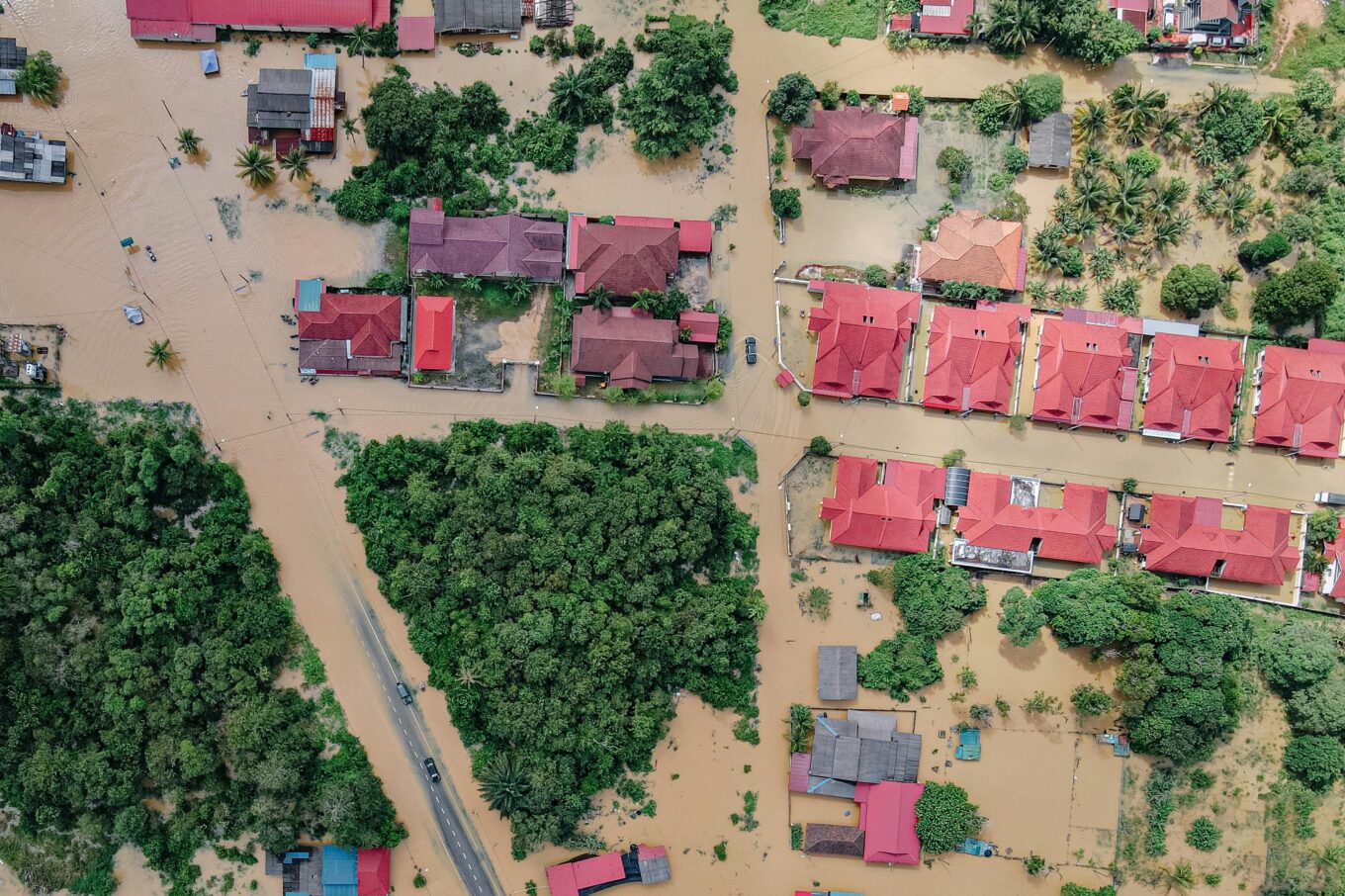
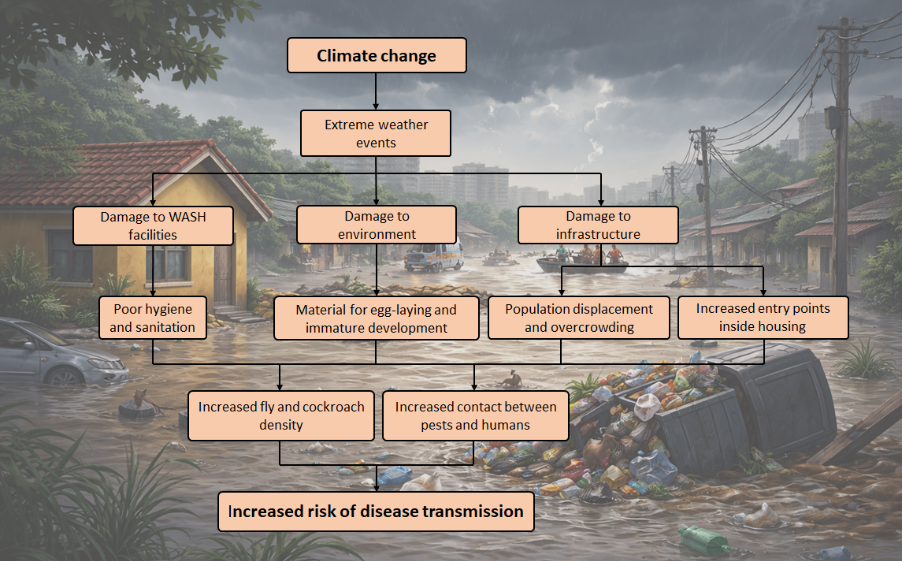
Extreme weather events damage infrastructure and reshape micro-environments. Floodwaters mobilise organic waste, sewage, and decomposing matter that provide food, egg-laying sites, and harbourage for insect pests. Heat accelerates insect development, while drought concentrates human activity around limited water sources. Together, these changes create ideal conditions for synanthropic insects (species that live alongside humans), often leading to rapid population increases.ii The elevated humidity associated with storms and flooding further favours their survival and reproduction.
Waste overflow, sanitation damage, and displacement
Climate disasters frequently overwhelm water, sanitation and hygiene (WASH) systems, including waste management and sanitation infrastructure. Latrines flood, refuse collection halts, drains clog, and food storage becomes insecure. At the same time, displacement forces people into crowded shelters or informal settlements where hygiene infrastructure is limited. These conditions accelerate pest activity by increasing access to food, reducing physical barriers between insects and living spaces, and disrupting routine cleaning and pest control practices. Flies move freely between sources of contamination, food, and household surfaces, while cockroaches exploit cracks, shelters, and power outages to forage indoors. The result is not just more insects, but more frequent and intense human–insect contact.iii
Rapid surges in flies, cockroaches and their pathogens
Unlike mosquitoes, flies exploit substrates for egg-laying and larval development that appear immediately after disruption, rather than waiting for standing water to form. A single female fly can lay hundreds of eggs over a short lifespan, development times are rapid, and dispersal is efficient.iv Although reproduction is slower in cockroaches, emerging nymphs readily acquire bacteria, viruses, protozoa, and helminth eggs on their bodies and deposit them on food, utensils, and household surfaces.v,vi Both pests act as mechanical transmitters of pathogens, meaning disease agents do not need to replicate inside the insect, unlike the complex biological transmission cycles seen with many mosquito-borne pathogens
In post-disaster settings, this creates elevated risks of food contamination, enteric infections, and diarrhoeal disease, with downstream effects on malnutrition and dehydration.vii These outcomes are rarely attributed explicitly to pests, yet they intersect directly with the leading causes of post-disaster morbidity.
Despite their importance, flies and cockroaches remain largely absent from climate adaptation frameworks, and vector control is often equated with mosquitoes alone. viii This matters. Climate change is not only expanding the ranges of disease vectors, it is amplifying exposure pathways that thrive on infrastructure failure. Domestic pests must be recognised, monitored, and managed as an under-recognised climate–health challenge.
Robert Jones has been supported by an unrestricted donation to LSHTM from Reckitt PLC for research on the intersection of hygiene and health.
References
[i] Thomson & Stanberry. Climate change and vector-borne diseases. N Engl J Med. 2022 Nov 24;387(21):1969-1978. doi: 10.1056/NEJMra2200092.
[ii] Owens. Some aspects of German cockroach population ecology in urban apartments. 1980. Thesis: Perdue University. Available from: https://docs.lib.purdue.edu/dissertations/AAI80
[iii] Hiscox et al. The impact of adverse weather events on cockroaches and flies, and the possible effects on disease Med Vet Entomol. 2025 Sep;39(3):500-514. doi: 10.1111/mve.12797. Epub 2025 Mar 7.
[iv] Sarwar. Life history of house fly Musca domestica Linnaeus (Diptera: Muscidae), its involvement in diseases spread and prevention of vector. International J Res Applied Nat Sci. 2016 2(7):31-42.
[v] Gioia et al. Pathogens associated with houseflies from different areas within a New York State dairy. JDS Commun. 2022 May 21;3(4):285-290. doi: 10.3168/jdsc.2021-0200. eCollection 2022 Jul.
[vi] Fischer et al., Nymphs of the Oriental cockroach (Blatta orientalis) as passive vectors of causal agents of avian tuberculosis and paratuberculosis. Med Vet Entomol. 2003 Jun;17(2):145-50. doi: 10.1046/j.1365-2915.2003.00417.x.
[vii] Yazdi et al. Infectious diarrhea risks as a public health emergency in floods; a systematic review and meta-analysis. Arch Acad Emerg Med. 2024 May 5;12(1):e46. doi: 10.22037/aaem.v12i1.2284. eCollection 2024.
[viii] IPCC Sixth Assessment Report. Climate Change 2022: Impacts, adaptation and vulnerability. https://www.ipcc.ch/report/ar6/wg2/